Every visitor to Athens makes their pilgrimage to the Acropolis, and rightfully so. The Parthenon, standing sentinel over the city for nearly 2,500 years, represents the pinnacle of ancient Greek civilization. But after three decades of calling Greece home, I've learned that Athens offers so much more than its famous hilltop monument. The city's true soul lies hidden in its labyrinthine neighborhoods, its bustling markets, and the everyday rituals of its residents.1
Anafiotika: A Cycladic Island in the Heart of Athens
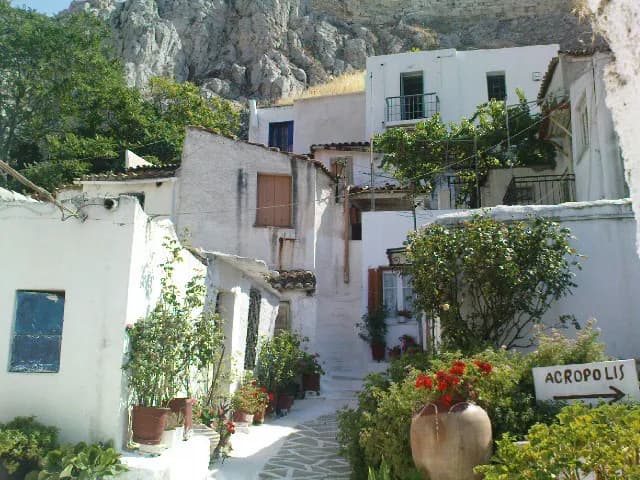
Tucked into the northeastern slope of the Acropolis, Anafiotika is perhaps Athens' best-kept secret. This tiny neighborhood, spanning just a few winding streets, feels like you've been transported to a Cycladic island. Whitewashed houses with blue shutters, bougainvillea cascading over stone walls, and cats lounging in sunny doorways create an atmosphere utterly distinct from the urban bustle below.2
The neighborhood's origins explain its unique character. In the 1840s, King Otto commissioned builders from the island of Anafi to help construct his new palace (now the Parliament building). These skilled masons, homesick for their island, recreated their native architecture right here on the Acropolis slopes. They built at night to avoid authorities who hadn't authorized the construction, invoking an Ottoman-era law that allowed any structure completed between sunset and sunrise to remain standing.3
Walking through Anafiotika today feels like stepping back in time. The narrow passages barely accommodate two people side by side. Elderly residents still tend tiny gardens in recycled olive oil tins. The Church of Agios Georgios tou Vrachou (St. George of the Rock) offers sweeping views across the city. I always tell my guests to visit in the early morning or late afternoon when the light turns golden and the day-trippers have departed.
The Central Market: Athens' Beating Heart
If you want to understand how Athenians actually live, skip the Plaka tourist restaurants and head to the Varvakeios Agora, Athens' central market. This covered market, operating since 1886, assaults the senses in the best possible way. The fish hall, with its mountains of glistening octopus, red mullet, and sea bream packed in ice, represents the Mediterranean's bounty. Next door, the meat market displays whole lamb carcasses and every imaginable cut, while vendors shout prices and banter with regular customers.4
Beyond the main halls, the surrounding streets host a sprawling network of specialty shops. On Evripidou Street, spice merchants have operated for generations, their shops fragrant with oregano, saffron, and mastika. Athinas Street offers everything from kitchen supplies to religious icons. The produce vendors on Sofokleous Street pile their stalls with seasonal treasures: wild greens in spring, watermelons in summer, chestnuts in fall.
The market serves both practical and social functions. This is where Greek grandmothers scrutinize fish eyes to assess freshness, where restaurant owners negotiate bulk purchases, and where neighborhood regulars gather for morning coffee and gossip. Several old-school tavernas hidden within the market's maze serve traditional fare to workers and in-the-know visitors. Try Epirus for exceptional grilled meats or Dipotto for plates of meze with carafes of house wine.
Exarchia: The Rebellious Heart
No neighborhood captures Athens' complex spirit quite like Exarchia. Known as the city's anarchist quarter, this densely packed area behind the National Archaeological Museum pulses with political energy, artistic expression, and an unapologetically alternative lifestyle. The walls serve as canvases for some of Europe's most striking street art—not mere graffiti, but elaborate murals addressing social issues, political commentary, and pure artistic expression.5
Exarchia's reputation as a hotbed of activism dates to the 1973 student uprising against the military junta, when tanks crushed a peaceful protest at the nearby Polytechnic University, killing at least 24 people. The neighborhood has never forgotten, and every November 17th, thousands march through its streets to commemorate the victims.6
Beyond its political identity, Exarchia offers some of Athens' most vibrant nightlife and creative energy. Independent bookshops line its streets, many specializing in rare editions and alternative literature. Vinyl record stores cater to serious collectors. Intimate live music venues host everything from experimental jazz to Greek folk revival. The plateia (central square) fills nightly with students, artists, and intellectuals debating over cheap beer and souvlaki.
While Exarchia has a reputation that gives some visitors pause, I've never felt unsafe walking its streets. Like any urban neighborhood, basic awareness applies. The reward is experiencing an Athens that exists far from the tourist trail—authentic, passionate, and utterly alive.
Koukaki: The New Favorite
Directly south of the Acropolis, Koukaki has emerged as one of Athens' most desirable neighborhoods. Once a working-class area, it now attracts young professionals, artists, and visitors seeking an authentic neighborhood experience. The tree-lined streets feature a perfect mix of traditional tavernas, modern wine bars, and independent boutiques.7
What makes Koukaki special is its livability. Unlike the tourist-saturated Plaka, restaurants here cater to Greek clientele, which keeps both quality high and prices reasonable. The neighborhood's residential character means quiet evenings punctuated by the sounds of children playing in small squares and neighbors chatting on balconies. Several excellent small hotels and apartment rentals make Koukaki an ideal base for visitors who prefer neighborhood immersion to hotel anonymity.
Don't miss a walk along Veikou Street, the neighborhood's main artery. At its southern end, Filopappou Hill offers arguably the best Acropolis views in the city—without the crowds of the Areopagus. The Philopappos Monument at the summit dates to 116 CE and honors a Roman senator of Greek descent. At sunset, the hill fills with locals walking dogs, couples sharing wine, and photographers capturing the Parthenon bathed in golden light.
Pangrati: Old Athens Charm
East of the Temple of Olympian Zeus, Pangrati remains refreshingly untouched by mass tourism. This established neighborhood, built largely in the 1920s and 1930s, features elegant neoclassical buildings, small workshops, and a genuine community feel. The Panathenaic Stadium, site of the first modern Olympics in 1896, marks its western boundary, but few visitors venture into the neighborhood itself.8
Plateia Proskopon, the neighborhood's central square, serves as the community's living room. Surrounding cafes fill with residents reading newspapers, families with young children, and elderly men playing backgammon. On weekends, an impromptu farmer's market springs up along adjacent streets, offering fresh produce, honey, and homemade preserves from producers throughout Attica.
Pangrati also hosts some of Athens' most interesting cultural spaces. The Stavros Niarchos Foundation Cultural Center, though technically in the neighboring Kallithea area, is easily accessible and offers world-class architecture, gardens, and programming. The First Cemetery of Athens, while a somber destination, features remarkable 19th-century funerary sculpture and serves as the final resting place for many notable Greeks.
Psyrri: From Workshops to Nightlife
Just west of Monastiraki Square, Psyrri has undergone a remarkable transformation. Once home to leather workers, metalworkers, and other craftsmen, the neighborhood's industrial buildings now house restaurants, bars, and creative studios. Yet traces of its working-class past remain: a few traditional workshops still operate, their craftsmen carrying on trades their families have practiced for generations.9
Psyrri comes alive at night. Its narrow streets, strung with lights and lined with outdoor tables, create an atmosphere somewhere between street festival and neighborhood gathering. Music spills from open doorways—Greek sounds from one venue, jazz from another, electronic beats from a third. The diversity reflects Athens' cultural complexity: traditional Greek tavernas operate steps from avant-garde cocktail bars.
For the best experience, wander without a fixed plan. Start with dinner at one of the area's excellent restaurants—Karamanlidika for traditional meze based on recipes from Anatolia, or Avli for updated Greek classics in a beautiful courtyard. Then follow the sounds that appeal to you, knowing that each establishment offers a different slice of contemporary Athenian life.
The Temple of Hephaestus: The Overlooked Marvel
While tourists pack the Acropolis, one of Athens' best-preserved ancient temples sits largely ignored in the Ancient Agora below. The Temple of Hephaestus, dedicated to the god of metalworking and craftsmanship, predates the Parthenon and remains in remarkably complete condition. Its Doric columns still support the original roof structure—a rarity among ancient Greek temples.10
The Ancient Agora itself deserves more attention than it typically receives. This was ancient Athens' civic heart, where Socrates debated philosophy, merchants hawked their wares, and citizens participated in the democratic process. The reconstructed Stoa of Attalos now houses an excellent museum displaying artifacts discovered during excavations. Walking the same paths where Plato and Aristotle once walked provides a connection to antiquity that the crowded Acropolis cannot match.
Practical Wisdom for Exploring Hidden Athens
Experiencing these neighborhoods requires a different approach than typical sightseeing. First, slow down. These areas reveal themselves to those who linger, not those rushing between checkpoints. Allow yourself to get mildly lost—Athens' compact center means you're never far from a landmark that can reorient you.
Second, adjust your schedule to local rhythms. Greeks eat late, typically not sitting for dinner until 9 PM or later. Afternoons, especially in summer, see many shops close for the traditional siesta. The city truly awakens after sunset when the heat breaks and residents emerge to socialize.
Third, embrace the coffee culture. Greeks don't grab coffee to go; they sit, often for hours, over a single freddo cappuccino or traditional Greek coffee. This ritual provides natural opportunities to observe neighborhood life and often leads to conversations with curious locals.
Finally, learn a few words of Greek. Unlike tourist zones where English suffices, these neighborhoods reward those who attempt the local language. Even a simple "kalimera" (good morning) or "efcharisto" (thank you) opens doors and earns smiles.
A City of Layers
Athens is a city of archaeological layers—Roman built upon Greek, Byzantine upon Roman, Ottoman upon Byzantine, modern upon all. But it's also a city of experiential layers. The surface Athens, visible to anyone with a guidebook and a few hours, offers genuine wonders. Yet beneath that surface lies another city entirely: the Athens where artisans still practice ancient crafts, where neighborhood tavernas serve recipes passed through generations, where political debates rage in packed squares, and where the Mediterranean rhythm of life continues largely unchanged despite the modern world's intrusions.
After thirty-five years of exploring this city, I still discover new corners, new characters, new perspectives. That's the magic of Athens: it never fully reveals itself. Each visit, each walk, each conversation adds another layer to understanding. The Acropolis will always command the heights, but the city's soul lives in the streets below—waiting for those willing to seek it out.
References
- Athens: A Cultural and Literary History — Signal Books, Michael Llewellyn Smith
- Anafiotika: The Island Village Hidden in Athens — Athens Social Atlas
- The History of Anafiotika — Athens Guide
- Varvakeios Agora: Athens Central Market — Greece High Definition
- Street Art in Exarchia — Athens Info Guide
- The Athens Polytechnic Uprising — Britannica
- Koukaki Neighborhood Guide — Athens Guide
- Pangrati: Authentic Athens — Culture Trip
- Psyrri: Athens' Creative Quarter — Discover Greece
- Temple of Hephaestus — World History Encyclopedia