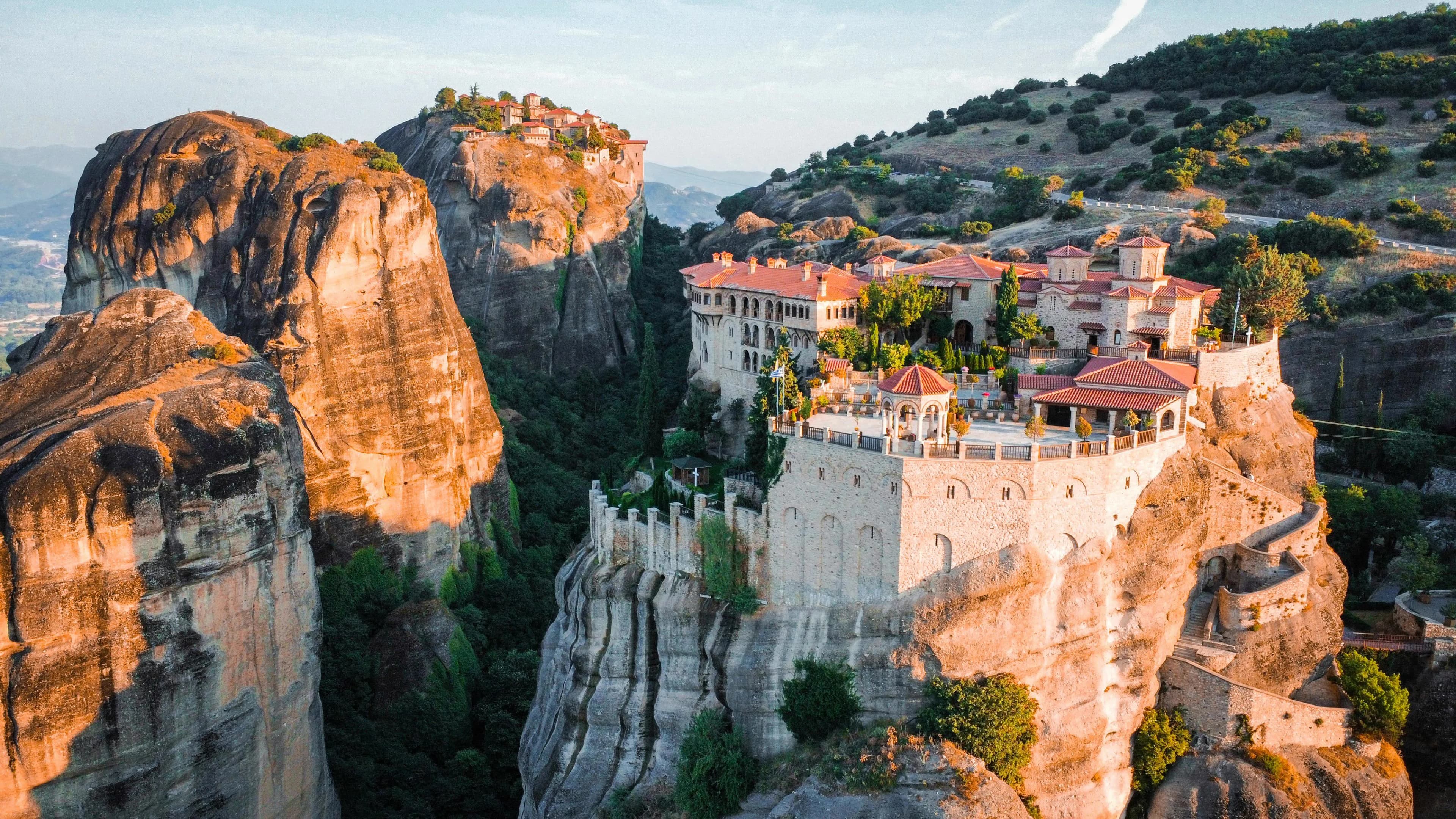
Some places defy description. You can study photographs, read accounts, and watch documentaries, yet nothing prepares you for the actual experience. Meteora is such a place. When I first rounded the bend in the road and saw those immense rock pillars rising from the Thessalian plain, crowned by monasteries that seemed to float in the sky, I understood why this site has drawn pilgrims and travelers for centuries. After countless return visits, the wonder has never diminished.1
A Geological Marvel
Before discussing the monasteries, we must acknowledge the natural phenomenon that made them possible. The rock formations of Meteora—the name derives from the Greek word for "suspended in air"—represent a geological wonder millions of years in the making. Some sixty million years ago, this region lay beneath a prehistoric sea. Rivers deposited sediment that eventually compressed into sandstone and conglomerate rock. Subsequent earthquakes and erosion shaped these deposits into the dramatic pillars we see today.2
The pillars reach heights exceeding 400 meters, their sheer faces and rounded tops creating a landscape unlike anything else on Earth. The rock surface, pockmarked with caves and crevices, provided natural hermitages for the first monks who sought solitude here over a thousand years ago. Standing at their base, looking upward at the monasteries perched on seemingly inaccessible summits, the mind struggles to comprehend how humans could build in such locations—let alone live there for centuries.
The Monastic Community
Hermits began inhabiting Meteora's caves in the 9th century, drawn by the isolation that facilitated spiritual contemplation. These early ascetics climbed the rocks using removable wooden scaffolding, pulling their ladders up behind them to ensure complete solitude. They gathered on Sundays and special feast days in a chapel at the foot of a rock called Doupiani, but otherwise lived in solitary prayer.3
The transformation from scattered hermitages to organized monasteries began in the 14th century. As the Byzantine Empire crumbled and Serbian raids threatened the region, monks sought more secure refuges. Athanasios Koinovitis, later Saint Athanasios of Meteora, founded the Great Meteoron monastery around 1340, establishing the model that others would follow. Over the following centuries, 24 monasteries would crown these rocky summits.4
The monasteries' golden age came in the 16th century, when they accumulated significant wealth and artistic treasures. Skilled craftsmen created frescoes that still adorn the monastery walls. Libraries assembled collections of rare manuscripts. The communities functioned as self-sufficient villages in the sky, complete with gardens, cisterns, and workshops—all supplied via nets and baskets hauled up the cliff faces on ropes.
The Six Active Monasteries
Of the original 24 monasteries, only six remain active today. Each offers a distinct character and experience, though all share the fundamental wonder of their impossible locations.
Great Meteoron (Megalo Meteoro), the oldest and largest monastery, sits atop the highest rock at 613 meters. Founded by Saint Athanasios, it served as the spiritual and administrative center of the Meteora community. The katholikon (main church) contains exceptional 16th-century frescoes depicting the persecution of Christians. The refectory now houses a museum displaying religious artifacts, manuscripts, and icons. The ossuary, containing the skulls of deceased monks, provides a sobering reminder of the contemplative life these men led.5
Varlaam, the second-largest monastery, perches on a rock that initially hosted the hermit Varlaam in the 14th century. After his death, the site remained empty until two brothers from Ioannina established the current monastery in 1517. The tower and reception area where supplies were historically winched up still function, though now primarily for restoration materials. The frescoes here, painted by Franco Catalano in 1548, rank among the finest in Meteora.
Roussanou (also called Saint Barbara) occupies a lower rock, making it relatively accessible while maintaining the vertiginous drama. The small monastery, run by nuns since 1988, offers particularly lovely views of the surrounding landscape. The gardens, tended by the resident sisters, provide a contemplative space often missed by hurried visitors.
Agios Nikolaos Anapafsas, meaning "of the repose," squeezes onto a narrow rock that required creative architectural solutions. The buildings stack vertically rather than spreading horizontally, creating an intimate atmosphere. The frescoes by the Cretan painter Theophanis Strelitzas, completed in 1527, demonstrate the sophisticated artistic production these remote monasteries could command.
Agios Stefanos, the most accessible monastery (a bridge connects it to the main road), houses nuns who maintain an active spiritual life alongside welcoming visitors. The newer katholikon, dating to the 18th century, contains the skull of Saint Charalambos, a revered relic. The older church, damaged by bombing during World War II, has been carefully restored.
Agia Triada (Holy Trinity) may be the most dramatically situated of all. Reaching it requires descending 140 steps cut into the rock, crossing a valley, then climbing 140 steps on the other side. This relative difficulty keeps crowds smaller, preserving a sense of isolation. The monastery gained wider fame as a filming location for the James Bond film "For Your Eyes Only," though the monks understandably downplay this association.6
Planning Your Visit
Visiting Meteora requires some planning to maximize the experience. The monasteries observe varying schedules, with different closing days and hours. Generally, they open in the morning, close for midday rest, and reopen in the afternoon. Confirming current schedules before your visit prevents disappointment.7
Dress codes apply throughout. Both men and women must cover their shoulders and knees. Women may be asked to wear skirts rather than pants; some monasteries provide wrap-around skirts at the entrance. These are active religious sites, and visitors should maintain appropriate decorum regardless of their personal beliefs.
Most visitors base themselves in Kalambaka, the town at Meteora's base, or the smaller village of Kastraki, nestled directly beneath the rocks. Both offer accommodation ranging from simple guesthouses to comfortable hotels. Kastraki provides a more atmospheric experience, with stunning rock views from many properties, while Kalambaka offers more dining and shopping options.
The question of how to visit the monasteries—by car, organized tour, or on foot—depends on your preferences and fitness level. Driving offers maximum flexibility; the road connecting the monasteries, while winding, is well-maintained. Organized tours handle logistics but impose rigid schedules. Walking between monasteries rewards the physically fit with perspectives impossible to achieve otherwise, but the distances and elevation changes are significant.
The Best Times to Visit
Timing significantly impacts the Meteora experience. The monasteries receive over two million visitors annually, and in high season (June-August), crowds can undermine the contemplative atmosphere that makes the site special.8
Spring (April-May) offers ideal conditions. The weather is pleasant without summer's heat, wildflowers blanket the valleys, and crowds remain manageable. The rocks often wear caps of mist in early morning, creating ethereal photographic opportunities. Easter, celebrated according to the Orthodox calendar, brings special significance—the monasteries conduct elaborate services, and the surrounding villages host traditional festivities.
Autumn (September-October) provides similarly favorable conditions. The summer crowds have departed, temperatures moderate, and the changing light gives the rocks an amber glow. The grape harvest in the surrounding Thessaly region adds agricultural interest to the visit.
Winter brings fewer visitors but less predictable conditions. Snow sometimes falls, dramatically transforming the landscape. Several monasteries close entirely during winter months. However, for those willing to brave the cold, a snow-dusted Meteora offers an incomparable sight.
Regardless of season, early morning and late afternoon provide the best experiences. The crowds thin, the light softens, and the spiritual purpose of these monasteries becomes more palpable. Arriving at Great Meteoron when it opens, before tour buses discharge their passengers, allows moments of genuine contemplation.
Beyond the Monasteries
While the monasteries rightfully command attention, Meteora offers additional experiences worth exploring. The rocks themselves attract climbers from around the world. More than a thousand climbing routes scale these pillars, ranging from moderate to extremely difficult. Local climbing schools offer instruction and guided climbs for beginners, providing a perspective on the rocks that no monastery visit can match.9
Hiking trails wind through the valley floor and up to various viewpoints. The paths connecting the monasteries, used by monks for centuries, offer immersion in the landscape impossible to achieve by car. The trail to Agia Triada, in particular, provides continuously changing perspectives on the surrounding rocks. Sunset from one of several dedicated viewpoints creates memories to last a lifetime.
The nearby town of Kalambaka, though often dismissed as merely a base for monastery visits, rewards exploration. The 10th-century Byzantine cathedral contains early frescoes and an unusual raised pulpit. The old town quarter, beneath the rocks, preserves traditional architecture increasingly rare in Greek towns. Several workshops continue craft traditions, including wood carving and weaving.
The Spiritual Dimension
It's possible to visit Meteora as a purely touristic exercise—ticking off monasteries, photographing views, buying souvenirs. But doing so misses something essential. These monasteries exist because centuries of monks sought extreme solitude to focus on spiritual matters. The very impracticality of their locations was the point: difficulty of access ensured the contemplative quiet necessary for religious devotion.10
Today's visitors, regardless of religious belief, can connect with this spiritual dimension. The monasteries still function as places of worship. Monks and nuns still devote their lives to prayer. The ancient liturgies still echo from Byzantine walls. Even for secular visitors, the experience of standing where humans have sought transcendence for a millennium can provoke reflection impossible in ordinary circumstances.
I always encourage visitors to spend at least a few moments in quiet contemplation. Find a corner of a courtyard away from other tourists. Listen to the wind across the rocks. Consider what drove monks to build in such impossible places, to devote their lives to something beyond material concerns. Whatever one's beliefs, Meteora's power derives from the intensity of human seeking it represents.
Practical Considerations
Reaching Meteora requires some effort but is straightforward. Trains connect Kalambaka with Athens (about five hours) and Thessaloniki (about three hours). Bus services also link the region with major cities. For maximum flexibility, renting a car in Athens or Thessaloniki allows exploration of the surrounding Thessaly region, including the traditional villages of the Pindus Mountains.
Most visitors find two full days sufficient to experience Meteora thoroughly. This allows visiting all six monasteries without rushing, catching sunset from a viewpoint, and perhaps hiking a few trails. Longer stays reward those interested in climbing, photography, or simply absorbing the atmosphere.
The monasteries charge modest admission fees, and photography is generally permitted in exteriors and some interior spaces, though flash photography and tripods are typically prohibited. Respect for the religious nature of the sites should guide visitor behavior throughout.
A Place Like No Other
In a world of manufactured attractions and curated experiences, Meteora offers something increasingly rare: genuine wonder. The combination of geological spectacle and human achievement creates a site without parallel. The rocks alone would constitute a natural marvel. The monasteries alone would represent an architectural and spiritual achievement. Together, they form something greater than either—a testament to nature's power and humanity's determination to seek meaning in impossible places.
Every traveler to Greece should witness Meteora. The journey requires effort, but the reward—standing atop those ancient rocks, surrounded by monasteries that have witnessed five centuries of prayer, looking across a landscape that seems designed to inspire awe—justifies any inconvenience. Some places change how you see the world. Meteora is such a place.
References
- Meteora: UNESCO World Heritage Site — UNESCO
- Geology of Meteora — Geology In
- Early Monasticism at Meteora — Britannica
- Saint Athanasios of Meteora — Orthodox Church in America
- Great Meteoron Monastery — Visit Meteora
- Holy Trinity Monastery in Film — Atlas Obscura
- Meteora Monastery Visiting Hours — Meteora.com
- Tourism Statistics for Meteora — Visit Greece
- Rock Climbing at Meteora — Climbing Greece
- Orthodox Monasticism — Greek Orthodox Archdiocese of America