Every country has its hidden treasures—places that somehow escape the tourist radar despite possessing extraordinary beauty and historical significance. In Greece, that place is Nafplio. Tucked into the northeastern corner of the Peloponnese, this elegant seaside town served as the country's first capital after independence from Ottoman rule. Today, it offers visitors something increasingly rare: an authentically Greek experience unmarred by mass tourism, wrapped in some of the most beautiful Venetian architecture in the Mediterranean.1
A Brief History of Greece's First Capital
Understanding Nafplio requires understanding its pivotal role in modern Greek history. When Greece won independence from the Ottoman Empire in the 1820s after a brutal war of liberation, the newly formed nation needed a capital. Athens, the obvious choice in retrospect, lay in ruins—a dusty village of perhaps 4,000 residents huddled beneath the Acropolis. Nafplio, by contrast, was a functioning city with infrastructure, defensive fortifications, and strategic positioning.2
From 1829 to 1834, Nafplio served as the capital of the fledgling Greek state. Ioannis Kapodistrias, Greece's first head of state, established his government here. The city's elegant neoclassical buildings date largely from this period, constructed to house the institutions of the new nation. Foreign ambassadors took up residence in Nafplio's grand homes. The first Greek currency was minted here. The first Greek newspaper was published here.
The capital era ended tragically when Kapodistrias was assassinated on the steps of the Church of Agios Spyridonas in 1831—you can still see the bullet hole in the church wall. By 1834, King Otto had transferred the capital to Athens, and Nafplio settled into a quieter existence. This quietude proved to be its preservation. While Athens grew chaotically into a modern metropolis, Nafplio remained essentially unchanged, its Venetian streets and neoclassical facades frozen in a more graceful time.3
The Old Town: A Living Museum
Nafplio's old town ranks among the finest preserved historic centers in Greece. Unlike so many Greek towns where concrete apartment blocks replaced traditional architecture during the 20th century's building boom, Nafplio maintained strict preservation standards. Walking its narrow streets today feels like stepping into a 19th-century watercolor.
The Venetians ruled Nafplio for centuries, and their influence permeates every corner. Elegant townhouses with wrought-iron balconies line the pedestrianized streets. Hidden courtyards reveal unexpected gardens fragrant with jasmine and bougainvillea. Small squares (plateias) anchor each neighborhood, their kafeneia (traditional coffeehouses) serving as de facto community centers where elderly men debate politics over endless cups of Greek coffee.4
Syntagma Square, the old town's central plaza, exemplifies Nafplio's layered history. The converted Venetian arsenal now houses an archaeological museum. The former mosque, built during Ottoman rule, serves as a conference center. Surrounding cafes occupy neoclassical buildings from the capital era. Greeks, tourists, and local students share the square's benches in a thoroughly Mediterranean scene.
The smaller Plateia Trion Navarchon (Three Admirals Square) commemorates the naval commanders whose combined fleet defeated the Ottomans at the Battle of Navarino in 1827, the decisive engagement that secured Greek independence. The square hosts some of Nafplio's best restaurants, their tables spilling across the cobblestones on warm evenings.
Palamidi Fortress: The Crown of Nafplio
Rising 216 meters above the town, Palamidi Fortress dominates Nafplio's skyline and represents one of the finest examples of Venetian military architecture anywhere in the Mediterranean. The Venetians constructed this massive fortification between 1711 and 1714 in a remarkably short seven years, employing the latest innovations in defensive design.5
The climb to Palamidi has become legendary among visitors. The official count is 999 steps, though the actual number varies depending on where you start counting. The ascent is strenuous—bring water and comfortable shoes—but the reward justifies every bead of sweat. From the fortress ramparts, views extend across the Argolic Gulf to the mountains of the Peloponnese. On clear days, you can see all the way to the island of Hydra.
The fortress itself rewards exploration. Eight distinct bastions connected by walls and tunnels create a complex that could garrison hundreds of soldiers. The dungeon where the Greek revolutionary hero Theodoros Kolokotronis was imprisoned remains accessible. Wandering the ramparts as the afternoon light softens, you feel the weight of history—all the sieges, the conflicts, the moments when control of this strategic position meant control of the region.
For those unable or unwilling to climb the steps, a road accessible by car or taxi winds up the back of the hill. Some visitors drive up and walk down, which is considerably easier on the knees. Regardless of approach, time your visit for late afternoon when the heat subsides and the light turns golden.
Bourtzi: The Island Fortress
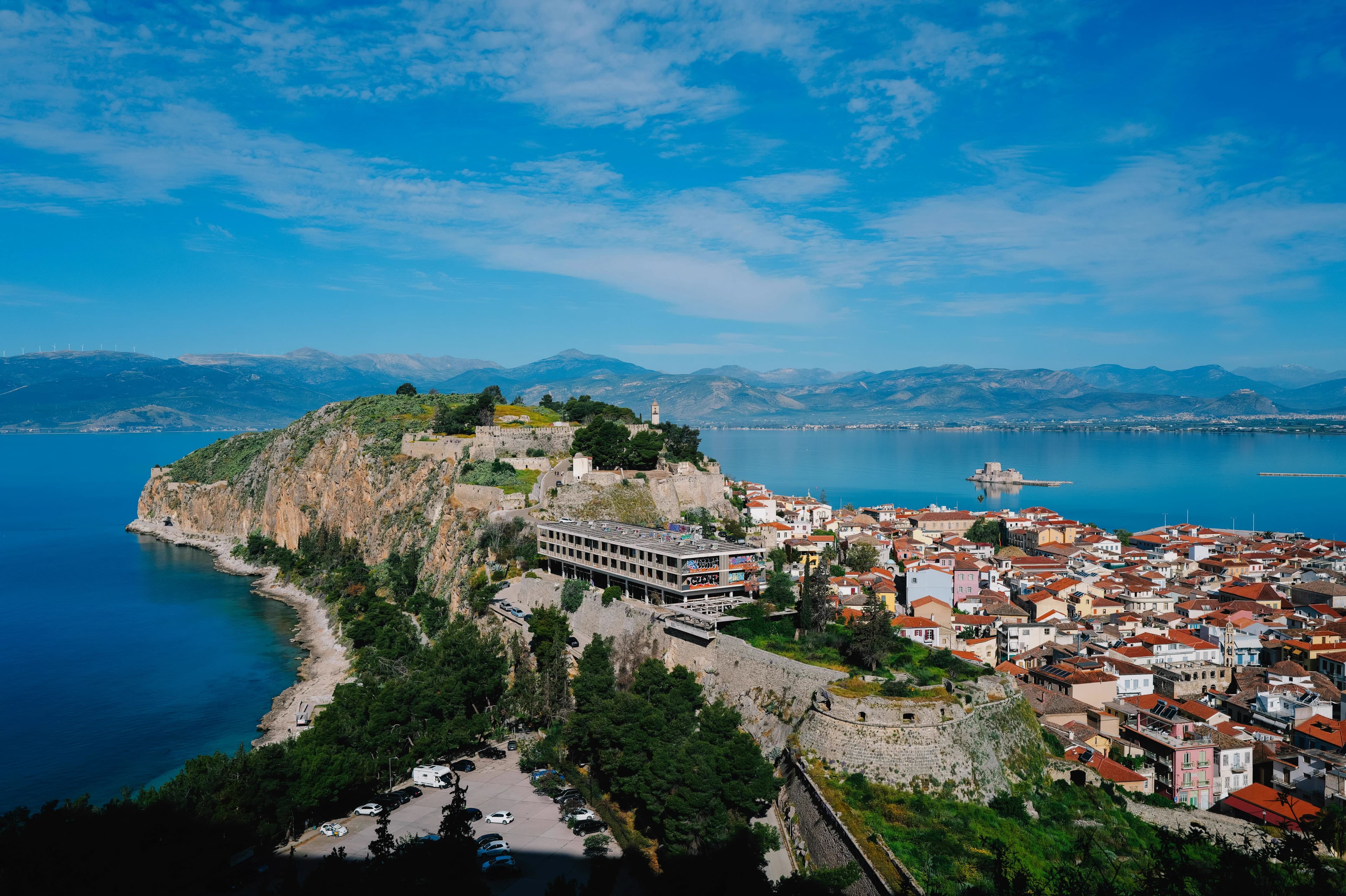
Sitting in the middle of Nafplio's harbor, the small island fortress of Bourtzi has become the town's defining image. This compact castle, built by the Venetians in 1473 to protect the harbor entrance, served various purposes over the centuries: fortress, residence for retired executioners, luxury hotel (briefly), and venue for summer festivals.6
Small boats ferry visitors from the harbor to Bourtzi throughout the day. The fortress itself doesn't offer extensive interior spaces, but walking its walls and contemplating the views back toward Nafplio and up to Palamidi creates a memorable experience. The surrounding waters, remarkably clear for a harbor, invite swimming on hot summer days—Greeks think nothing of diving off the rocks into the sea.
Bourtzi looks particularly magical at night when illuminated against the dark harbor. The waterfront promenade, lined with cafes and restaurants, provides perfect vantage points for evening viewing. Order a carafe of local wine, watch the fishing boats return with their catch, and let the fortress's silhouette against the twilight sky work its enchantment.
Acronafplia: The Original Settlement
Before Palamidi, before the Venetian old town, there was Acronafplia—the rocky promontory where Nafplio's earliest inhabitants settled thousands of years ago. Archaeological evidence suggests continuous occupation since prehistoric times. The Mycenaeans fortified the site. The Byzantines strengthened the walls. The Franks, Venetians, and Ottomans each left their marks.7
Today, Acronafplia offers a counterpoint to the busier attractions. Several pleasant hotels occupy the former fortress buildings, their terraces enjoying spectacular views. Walking paths wind through the fortifications, passing Byzantine churches, Venetian structures, and Ottoman additions. The atmosphere feels contemplative, removed from the lively streets below.
The Xenia Hotel, a modernist structure built into the fortifications in the 1960s, represents a fascinating architectural intervention. Currently closed for renovation, it demonstrates Greece's sometimes awkward relationship with its historical heritage—the impulse to modernize occasionally colliding with preservation imperatives.
Beyond the Town: Day Trips and Excursions
Nafplio's location makes it an ideal base for exploring the Argolid region, home to some of Greece's most significant archaeological sites. Within easy driving distance, you'll find enough ancient wonders to occupy several days of exploration.
Mycenae, the legendary kingdom of Agamemnon, lies just 25 kilometers north. The Lion Gate, the Treasury of Atreus (a massive domed tomb), and the citadel ruins evoke the Bronze Age civilization that dominated Greece three thousand years ago. Heinrich Schliemann's 19th-century excavations here revolutionized archaeology and fired the public imagination about ancient Greece.8
Epidaurus, approximately 30 kilometers east, preserves the ancient world's most acoustically perfect theater. Built in the 4th century BCE, the theater still hosts summer performances during the Athens and Epidaurus Festival. Attending a performance of ancient Greek drama in the very type of venue for which it was written creates an unforgettable experience. Even without a performance, the site—which includes an extensive sanctuary to Asklepios, the god of healing—merits a half-day visit.
Tiryns, often overlooked despite its proximity to Nafplio, offers massive Cyclopean walls that rivaled those of Mycenae. The ancient citadel, mentioned in Homer, demonstrates the engineering capabilities of Bronze Age Greeks. Its relative obscurity means you'll often have the site largely to yourself.
The Culinary Scene
Nafplio's restaurant scene punches well above its weight for a town of roughly 15,000 residents. The Argolid region produces excellent olive oil, citrus, and vegetables, and local chefs make good use of these ingredients. The proximity to the sea ensures fresh fish, while the surrounding mountains supply quality lamb and pork.9
Traditional tavernas cluster in the old town's quieter back streets. Look for places where Greeks outnumber tourists—always a reliable indicator. These family-run establishments serve dishes you'll find throughout Greece, but executed with particular care: grilled lamb chops, roasted vegetables glistening with olive oil, fresh salads of tomato and cucumber topped with creamy feta.
Several more contemporary restaurants have emerged in recent years, their chefs applying modern techniques to traditional ingredients. These establishments typically occupy renovated historic buildings, their contemporary aesthetics contrasting pleasingly with ancient walls. Reservations become essential on summer weekends when Athenians descend on the town.
Don't miss Nafplio's signature gelato. Several excellent gelaterias operate in the old town, their existence reflecting centuries of Venetian and Italian influence. On warm evenings, half the town seems to be strolling the waterfront with gelato in hand—a tradition as Mediterranean as the sunset coloring the sky.
Beaches and Swimming
While not primarily a beach destination, Nafplio offers several swimming options for those wanting to combine culture with seaside relaxation. Arvanitia Beach, tucked beneath Acronafplia, is accessible via a pleasant seaside path from the old town. The small pebble beach gets crowded in high season but remains pleasant in spring and fall.10
Karathona Beach, a few kilometers south of town, provides a larger stretch of sand backed by olive groves. A seasonal bus connects the beach with the center, though renting a car offers more flexibility. Several tavernas at Karathona serve fresh fish to bathers taking a break from the sun.
For more serious beach time, the Argolid coastline offers numerous options within short driving distance. Tolo, a small resort town about 10 kilometers south, has a long sandy beach with full tourist infrastructure. Further afield, the beaches near Ermioni and Porto Heli attract those seeking more upscale environments.
Practical Matters
Reaching Nafplio from Athens takes approximately two hours by car or bus, making day trips feasible though overnight stays far more rewarding. The drive follows modern highways for most of the journey before descending through olive groves to the coast. Buses depart regularly from Athens' Kifissos station.
The best time to visit depends on your priorities. Summer brings the liveliest atmosphere and warmest swimming, but also the largest crowds and highest temperatures—Palamidi's 999 steps become considerably more challenging in August heat. Spring (April-May) and fall (September-October) offer ideal conditions: pleasant temperatures, manageable crowds, and the surrounding countryside at its most beautiful.
Accommodation ranges from simple pensions in the old town to boutique hotels in restored mansions. Several properties occupy buildings with genuine historical significance, their rooms combining period details with modern comforts. Book well in advance for summer weekends when Athenians flood the town.
The Essence of Nafplio
What makes Nafplio special extends beyond its monuments and history. The town possesses an intangible quality—call it atmosphere, ambiance, or simply Greek charm—that's increasingly difficult to find in more heavily touristed destinations. Life here moves at a human pace. Shop owners chat with regular customers. Families gather in the squares as evening approaches. The rhythm follows centuries-old patterns despite the modern world's intrusions.
This authentic Greek character, combined with genuine historical significance and extraordinary beauty, makes Nafplio essential for any serious exploration of Greece. Come for the Venetian architecture and Byzantine churches. Stay for the evening passeggiata along the waterfront, the morning coffee in a shaded square, the sense of having discovered something real in an age of manufactured experiences. In Nafplio, Greece reveals itself not as a museum piece but as a living culture, welcoming visitors into its embrace with characteristic Mediterranean warmth.
References
- Nafplio: The First Capital of Modern Greece — Discover Greece
- Greek War of Independence — Britannica
- Ioannis Kapodistrias: First Governor of Greece — Hellenic Parliament
- Venetian Architecture in Greece — Ancient Origins
- Palamidi Fortress — Kastra.eu - Greek Castles
- Bourtzi Castle History — City of Nafplio
- Acronafplia Archaeological Site — Hellenic Ministry of Culture
- Mycenae: Palace of Agamemnon — UNESCO World Heritage
- Argolid Regional Cuisine — Greek Gastronomy Guide
- Nafplio Beaches Guide — Greeka