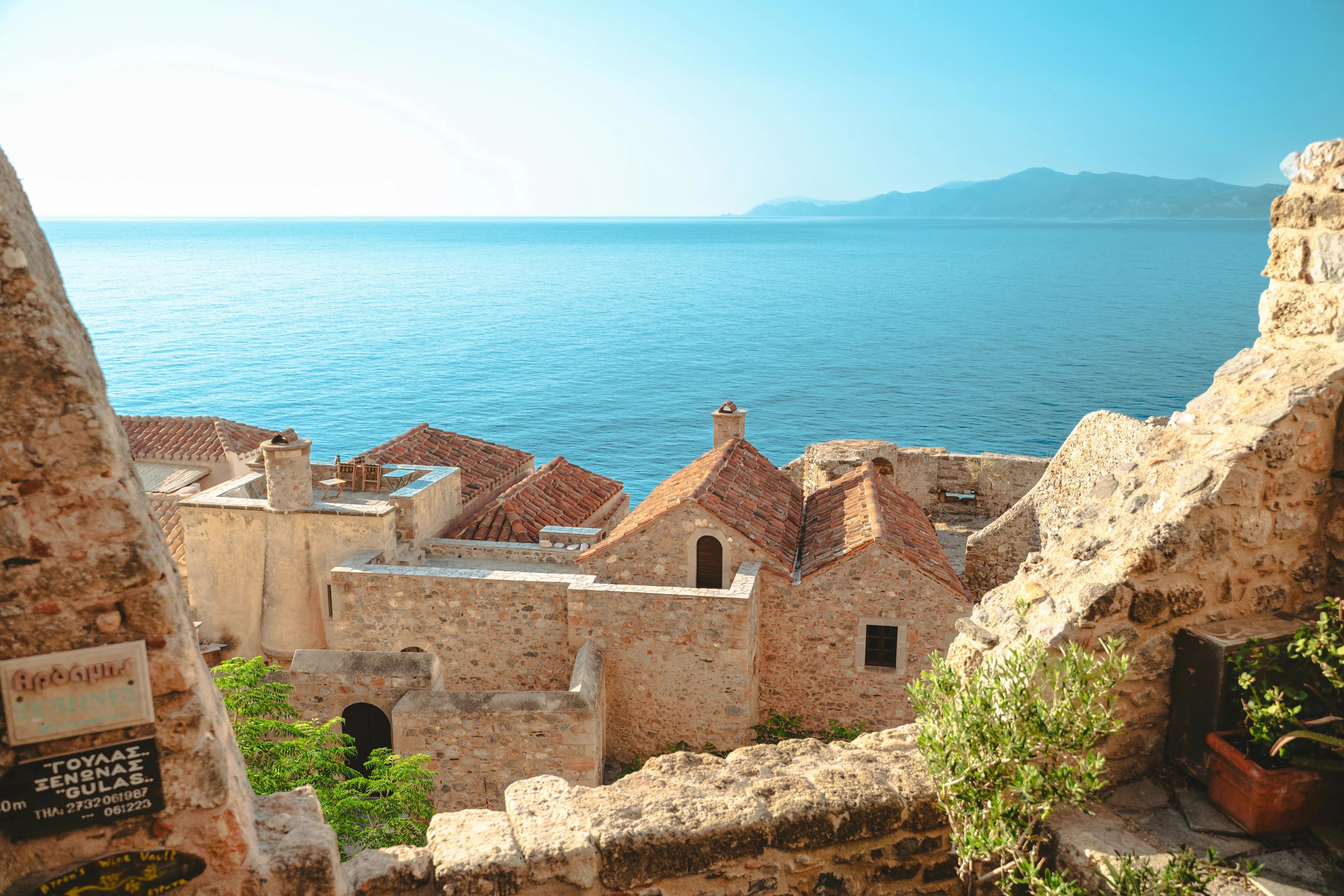
The first glimpse of Monemvasia stops visitors in their tracks. Approaching from the mainland, the massive rock appears to rise directly from the sea, its sheer cliffs revealing no sign of the medieval town hidden on its southeastern face. Only upon crossing the narrow causeway and passing through the fortress gate does Monemvasia reveal itself: a complete Byzantine town preserved in stone, its narrow lanes, ancient churches, and weathered mansions seemingly untouched by the centuries that have passed.1
The Rock and Its History
Monemvasia's name derives from two Greek words: "moni" (single) and "emvasia" (entrance). The name perfectly describes the town's geography and its historical significance. This massive rock, connected to the Peloponnese by a single causeway, offered a naturally defensible position exploited by successive civilizations for over a millennium.2
The town's founding dates to the 6th century CE, when inhabitants of ancient Laconia fled to this rock to escape Slavic invasions. The position proved impregnable. For centuries, Monemvasia resisted sieges that would have overwhelmed any conventional fortification. Its walls needed only to protect the narrow western approach; the cliffs provided natural defense on all other sides.
Byzantine Monemvasia flourished as a commercial center, its protected harbor serving the maritime trade routes connecting Constantinople with the western Mediterranean. The famous Malmsey wine, prized throughout medieval Europe, took its name from the Italian corruption of "Monemvasia"—the port from which it was shipped. At its peak, the town housed a population of perhaps 40,000, making it one of the Byzantine Empire's most important cities.3
The Venetians controlled Monemvasia for much of the 15th through 18th centuries, leaving architectural traces that blend with the earlier Byzantine structures. The Ottomans held the town briefly but never fully subdued its Greek character. When Greece won independence in the 1820s, Monemvasia had already begun its long decline, its commercial importance superseded by other ports, its population dwindling to a few hundred souls.
The Lower Town: A Living Museum
Entering Monemvasia through the massive gate in its western wall feels like stepping through a portal into the medieval past. Vehicles cannot enter; the narrow stone lanes barely accommodate two people walking abreast. No modern intrusions disturb the atmosphere: no electrical wires mar the views, no neon signs compete with ancient stonework. The Greek government has enforced strict preservation standards, requiring any renovation to respect traditional materials and methods.4
The lower town's main street curves through the settlement, lined with stone buildings that have housed shops for centuries. Today these spaces contain restaurants, cafes, and small hotels rather than medieval merchants, but the structures themselves remain largely unchanged. Side alleys branch off into quieter residential areas, their worn stone steps climbing toward the upper reaches of the rock.
Churches punctuate the urban fabric, their modest exteriors belying the treasures within. The Elkomenos Christos (Christ in Chains), the oldest church in the lower town, dates to the 12th century. Its carved marble iconostasis and fragmentary frescoes represent Byzantine artistry at its finest. The Church of Panagia Chrysafitissa, built into the cliff face, demonstrates the ingenious adaptation to challenging terrain that characterizes Monemvasia's architecture.
The main square opens unexpectedly after the confining lanes, its cannonball-embedded pavement testifying to past sieges. The mosque, converted from a Byzantine church during Ottoman rule, now houses a small museum. Surrounding cafes offer the first opportunity to sit and absorb the atmosphere while contemplating the sea views that open to the east.
The Upper Town: Ruins and Revelation
Above the inhabited lower town, the ruins of the upper citadel sprawl across the rock's summit. A steep path—not for those uncomfortable with heights or exertion—climbs to this abandoned settlement, passing through a second defensive gate into a landscape of crumbling walls and roofless buildings.5
The upper town housed Monemvasia's elite during the Byzantine period. Noble families built mansions here, their cisterns still visible among the ruins. The citadel included barracks, storage facilities, and the governor's residence. Today, goats pick their way among the stones, the only inhabitants of what was once a thriving community.
The Church of Agia Sofia crowns the upper town, perched dramatically at the cliff's edge. This 12th-century church, modeled on the Daphni Monastery near Athens, represents one of the finest surviving examples of Byzantine architecture in the Peloponnese. Its octagonal dome, supported on squinches, creates an interior of unexpected spaciousness. Fragmentary frescoes hint at the splendor that once covered every surface. The setting, with views extending across the Laconian Gulf to the Taygetos Mountains, makes this one of Greece's most memorable sacred spaces.
The climb to the upper town rewards not just with the church but with perspectives impossible to achieve from below. The lower town spreads beneath you, its red-tiled roofs creating a warm contrast against the gray stone. The mainland stretches to the west, the sea to the east. The scale of the rock becomes apparent only from this vantage point—its cliffs dropping hundreds of meters to the waves below.
Staying in Monemvasia
Monemvasia offers one of Greece's most unusual accommodation experiences. Several carefully restored mansions now operate as small hotels, their thick stone walls and vaulted ceilings providing atmospheric lodgings impossible to replicate elsewhere. Staying overnight—essential for the full experience—means having the town largely to yourself after day-trippers depart.6
The hotels range from simple to luxurious, but all share certain characteristics: the absence of elevators (impossible in these ancient structures), the presence of steep stairs and uneven floors, the wonderfully cool temperatures maintained by massive stone walls even in summer. Some rooms incorporate Byzantine architectural elements; others feature Ottoman-era details. All require guests to leave vehicles in the mainland parking area and carry their own bags across the causeway.
This inconvenience filters out a certain type of tourist. Those who stay in Monemvasia tend to appreciate what makes it special: the silence after dark, broken only by waves against the rocks; the morning light creeping across ancient stonework; the sense of inhabiting rather than merely visiting history. The town's small permanent population—perhaps 50 year-round residents—creates a genuine community rather than a tourist village.
Beyond the Rock: The Surrounding Region
While Monemvasia itself could occupy several days of exploration, the surrounding Laconia region offers additional attractions worth discovering. The mainland village of Gefyra, across the causeway, provides more accommodation options and a selection of restaurants catering to visitors. The nearby beaches, uncrowded even in high season, offer swimming to complement cultural exploration.7
The drive to Monemvasia passes through some of the Peloponnese's most beautiful but least-visited landscapes. The eastern coast road from Leonidio winds spectacularly between mountains and sea, passing tiny fishing villages and empty beaches. Inland, the villages of Mount Parnon preserve traditional architecture and customs increasingly rare in modern Greece.
For those with additional time, the combination of Monemvasia with Mystras (the Byzantine ghost city near Sparta) and the Mani Peninsula creates an itinerary showcasing the Peloponnese's extraordinary historical and natural diversity. Few tourists venture to this southeastern corner of the peninsula, yet it contains some of Greece's most rewarding destinations.
The Rhythm of Monemvasia
Life in Monemvasia follows patterns shaped by the rock itself. The town faces east, greeting the sunrise but losing direct light by mid-afternoon as the cliff's shadow creeps across the buildings. Summer afternoons turn drowsy; shutters close, cats seek shade, visitors retreat to their cool stone rooms. Evening brings revival: restaurants set tables in lanes still warm from the day's heat, wine flows, conversation rises.8
The absence of vehicles creates a particular quality of silence. Without engine noise, you hear the elements: wind across stone, waves against cliff, the bells of distant churches. You hear human sounds too—footsteps echoing on stone, conversations drifting from open windows, the clink of glasses in evening cafes. This acoustic intimacy reinforces the sense of time travel, of experiencing a world before the internal combustion engine transformed human settlement.
Walking the lanes at different hours reveals different towns. Early morning belongs to cats and the few year-round residents, their routines undisturbed by visitors still sleeping. Midday brings day-trippers from the mainland, their numbers overwhelming the narrow streets for a few hours. Late afternoon sees their departure, followed by the leisurely emergence of overnight guests for the evening passeggiata. Night belongs to those who've stayed: the lanes nearly empty, the stars brilliant above, the town reclaimed by darkness as it was for centuries before electricity arrived.
Practical Matters
Reaching Monemvasia requires effort that keeps mass tourism at bay. No airport serves the region; no train comes closer than distant Sparta. The drive from Athens takes approximately four hours, the final stretch following a winding coastal road that discourages tour buses. This inaccessibility is precisely Monemvasia's protection—the investment required to visit filters for travelers willing to seek something special.9
Once arrived, visitors face the question of duration. Day trips are possible but miss the essence of the experience. A single overnight stay allows evening and morning exploration when the town belongs to its guests. Two nights permit the climb to the upper town, a swim at nearby beaches, and the leisurely absorption of atmosphere that Monemvasia rewards. Longer stays suit those content to read, walk, eat, and simply exist in this remarkable place.
The town has limited dining options—perhaps a dozen restaurants and cafes—but quality compensates for quantity. Fresh fish from the local waters, vegetables from mainland gardens, the excellent wines of the Laconia region: meals in Monemvasia can be memorable. Reservations become wise in high season when overnight guests outnumber available tables.
The Preservation of Magic
Monemvasia's survival seems almost miraculous. The 20th century destroyed countless historic towns throughout Greece, their traditional buildings demolished for concrete apartments, their lanes widened for automobiles, their character erased by modernization. Monemvasia's inconvenient geography—the impossibility of bringing vehicles onto the rock, the expense of any construction—protected it from this fate.10
Today, careful preservation efforts maintain what time and neglect might otherwise have destroyed. The Greek government, recognizing Monemvasia's unique heritage, has invested in restoration while restricting inappropriate development. Private owners have converted ruins into homes and hotels, creating economic activity that supports ongoing preservation. The balance remains delicate—too many visitors could destroy what makes the town special, while too few would remove the economic rationale for preservation.
For now, Monemvasia represents one of Europe's most complete medieval townscapes, a place where the past remains palpably present. The experience of walking its lanes, sleeping within its walls, watching sunset from its ramparts creates memories unlike any other destination in Greece. The rock has survived sieges, empires, and centuries of neglect. May it survive tourism as well, preserved for future generations seeking connection with a vanished world.
A Place Apart
After countless visits to Monemvasia, I remain moved by its singular power. No other place in Greece combines natural drama with historical depth quite so effectively. The rock creates the conditions for the town; the town gives meaning to the rock. Together they form something greater than either component: a meditation on persistence, on the human capacity to create beauty in unlikely places, on the possibility of preserving past within present.
Travelers seeking the familiar comforts of modern tourism should look elsewhere. Monemvasia offers no beaches within the walls, no swimming pools, no nightclubs, no chain establishments of any kind. What it offers instead is increasingly rare: authenticity, atmosphere, the chance to briefly inhabit another time. For those who value such experiences, Monemvasia ranks among Greece's essential destinations—a secret that has somehow remained hidden in plain sight.
References
- Monemvasia: History and Heritage — Discover Greece
- Byzantine Monemvasia — Britannica
- Malmsey Wine and Monemvasia — Wine Enthusiast
- Monemvasia Preservation — UNESCO Tentative List
- Upper Town of Monemvasia — Greek Castles
- Staying in Monemvasia — Lonely Planet
- Laconia Region Guide — Visit Greece
- Life in Monemvasia — Greece Travel Ideas
- Getting to Monemvasia — Greeka
- Conservation of Historic Monemvasia — Monumenta