Another must-see in the Argolid Peninsula is the magnificent site of Mycenae, a place that transports visitors back 3,500 years to the height of one of the ancient world's most powerful civilizations. The Mycenaeans, who take their name from this famous citadel, dominated the eastern Mediterranean during the Late Bronze Age, and the ruins they left behind remain among the most impressive and evocative in all of Greece.1
Myth and History Intertwined
In Greek mythology, Atreus, the son of Pelops (from whom the Peloponnese, meaning "island of Pelops," takes its name), was one of the first kings of Mycenae. He was also the father of Agamemnon and Menelaus, whose wife Helen was taken to Troy, setting off the Trojan War as described in Homer's Iliad. Mycenae is also the setting for Aeschylus's tragic trilogy, The Oresteia, which tells the dark tale of Agamemnon's murder by his wife Clytemnestra upon his return from Troy, and the cycle of vengeance that followed.2
For centuries, Mycenae existed primarily in these myths and legends. The city was last inhabited over 2,000 years ago, and while its massive cyclopean walls and famous Lion Gate remained visible through the ages, the full extent of its grandeur was not revealed until systematic excavation began roughly 150 years ago. The archaeological remains date primarily to the 14th and 13th centuries BCE, when scholars agree that Mycenae was at the peak of its economic, political, and religious power.
The Lion Gate and Cyclopean Walls
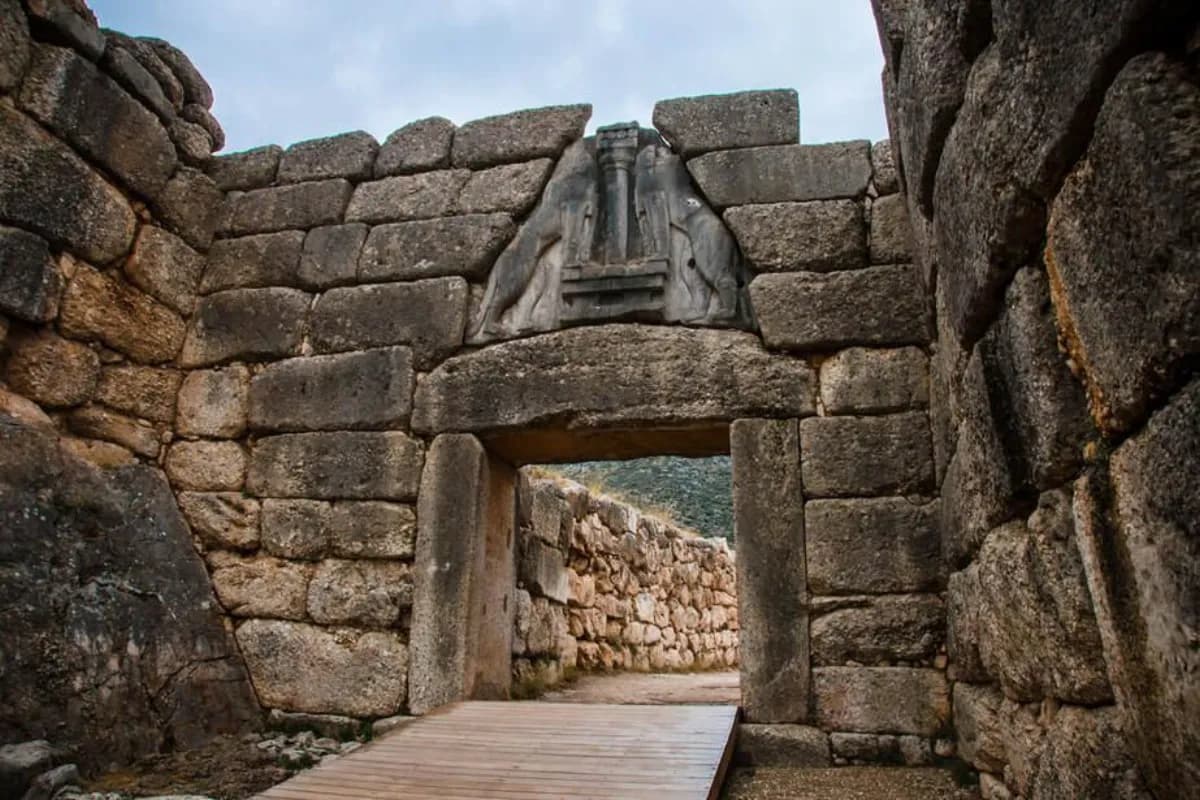
The entrance to the citadel through the Lion Gate is one of the most iconic moments in any visit to Greece. This monumental gateway, built around 1250 BCE, features a massive limestone relief of two lions (or lionesses) flanking a central column, the oldest monumental sculpture in Europe. The gate and the enormous walls surrounding the citadel are built from stones so large that later Greeks believed only the Cyclopes, the mythical one-eyed giants, could have moved them, hence the term "cyclopean" masonry that archaeologists still use today.3
Passing through the Lion Gate and walking into the citadel, you follow in the footsteps of kings, warriors, priests, and merchants who traversed this same threshold three millennia ago. The sheer scale of the fortifications speaks to Mycenae's power and the resources its rulers commanded.
Schliemann's Golden Treasures
It was Heinrich Schliemann, the German businessman turned archaeologist, who made Mycenae world-famous again. Excavating in the 1870s, Schliemann uncovered a treasure trove of beautifully crafted gold objects that stunned the world: death masks, including the famous Mask of Agamemnon, golden diadems, ornate drinking cups, bronze swords and daggers with gilded decorations, and exquisite objects such as the famous bull's head rhyton.4
Most of these extraordinary finds came from the shaft tombs of Grave Circle A, a special burial place situated on the right-hand side just after entering the citadel through the Lion Gate. The wealth and artistry of the grave goods revealed a civilization of remarkable sophistication, one that traded with Egypt, the Near East, and across the Mediterranean. The finest pieces are now displayed in the National Archaeological Museum in Athens, where they remain among the most prized objects in the collection.
The Treasury of Atreus
Also intriguing are the tholos, or beehive tombs, which replaced the shaft grave as the burial of choice for the Mycenaean elite at the beginning of the Late Bronze Age. These architectural marvels can be found across the southern Peloponnese, but the largest and most famous is the so-called Treasury of Atreus at Mycenae, located just outside the citadel walls.5
Approaching the Treasury of Atreus through its long entrance corridor (dromos), flanked by towering stone walls, is a genuinely awe-inspiring experience. The doorway itself is topped by an enormous lintel stone estimated to weigh over 100 tonnes. Inside, the beehive-shaped chamber rises to a height of over 13 meters, constructed from precisely fitted stone courses that taper inward to a central point. When it was built around 1250 BCE, this was the largest dome in the world, and it would remain so for over a thousand years until the Romans built the Pantheon.
Nearby: Tiryns and Midea
Close to Mycenae are the Mycenaean citadels of Midea and Tiryns, whose ancient king Eurystheus famously imposed the Twelve Labors onto Herakles. Tiryns is located next to the lovely city of Nafplio and features cyclopean walls that rival those of Mycenae itself. Its underground galleries, built within the massive fortification walls, are among the most impressive surviving examples of Mycenaean military architecture. Both Mycenae and Tiryns are UNESCO World Heritage Sites.6
Together, Mycenae, Tiryns, and the surrounding sites offer an unparalleled window into Bronze Age Greece. Combined with the charm of nearby Nafplio as a base, the beauty of the Argolid landscape, and the proximity of Epidaurus, this region deserves several days of unhurried exploration. Whether you come for the mythology, the archaeology, or simply the thrill of walking through a gate that has stood for over three thousand years, Mycenae delivers an experience that stays with you long after you leave.
References
- Archaeological Sites of Mycenae and Tiryns — UNESCO World Heritage
- Mycenae in Greek Mythology — Britannica
- The Lion Gate at Mycenae — World History Encyclopedia
- Schliemann and the Mask of Agamemnon — National Archaeological Museum of Athens
- Treasury of Atreus — World History Encyclopedia
- The Citadel of Tiryns — Discover Greece