People come to me every week with a version of the same ten-day itinerary they've built themselves: three nights in Athens, a night in Santorini, two nights in Mykonos, a day trip to Delphi wedged in somewhere, and a "quick stop" in Nafplio they've read about but can't quite place on the map. On paper it looks efficient. In practice, it's exhausting, and I've watched enough guests limp through the back half of a trip like this to know it rarely delivers what they actually came for. After three decades of calling Greece home and building trips for a living, I've settled on a simpler rule: ten days should mean two places, done properly, not five places done in passing.1
The Mistake Almost Everyone Makes First
The overpacked itinerary is the single most common thing I have to talk guests out of. It comes from a good instinct—you're only here once, so why not see everything—but Greece punishes that instinct more than most countries. Ferries run on their own schedule and get cancelled by wind with no warning. Athens traffic eats an hour you didn't budget. A "one night" stop means you arrive tired, sleep, and leave before you've understood where you are. I always tell my guests that the single best change they can make to a draft itinerary is to delete a stop, not add one. Ten days spent in Athens plus one well-chosen region, explored at a human pace, will beat a five-stop sprint every time, and it will also be the version of the trip you actually remember clearly a year later.
So the shape I build for almost every first-time guest is this: two to three days in Athens, then one region for the remaining week, chosen for what kind of trip you actually want rather than what's trending on Instagram.
Days 1–3: Athens, Properly
Give Athens three full days if you can, two at an absolute minimum. Day one is the Acropolis, the Acropolis Museum, and the Plaka—go early, before the tour buses, and you'll have the Parthenon nearly to yourself for the first hour. Day two is where the city actually opens up: the Ancient Agora and the Temple of Hephaestus in the morning, then an afternoon in one of the neighborhoods most visitors skip entirely. I've written before about what Athens looks like beyond the Acropolis, and I mean it when I say those neighborhoods—Anafiotika's whitewashed lanes, the Central Market, Koukaki's evening café culture—are where the city's actual personality lives. Day three, if you have it, is for the National Archaeological Museum in the morning and a slower afternoon: a long lunch, a walk up Filopappou Hill for sunset, dinner somewhere in Pangrati where the tables around you are speaking Greek, not English.
Jet lag is a real factor here too. Most guests fly in overnight and land groggy; building a light first day rather than a packed one keeps the rest of the trip from starting on the back foot. I usually schedule the Acropolis for day two rather than the morning after an overnight flight, and let day one be a slow walk through the Plaka, a long lunch, and an early night instead.
Where you stay matters more than most guests expect, too. Koukaki and Plaka put you within walking distance of the major sites, which is worth the slightly higher rate if you're only here a few days—you'll get back an hour or more each day that would otherwise go to taxis and traffic. If you're the kind of traveler who wants a genuine neighborhood feel over convenience, Pangrati or Koukaki in the evenings, once the day-trip crowds have thinned, show you an Athens that most itineraries never touch.
Ferry or Flight: How to Actually Decide
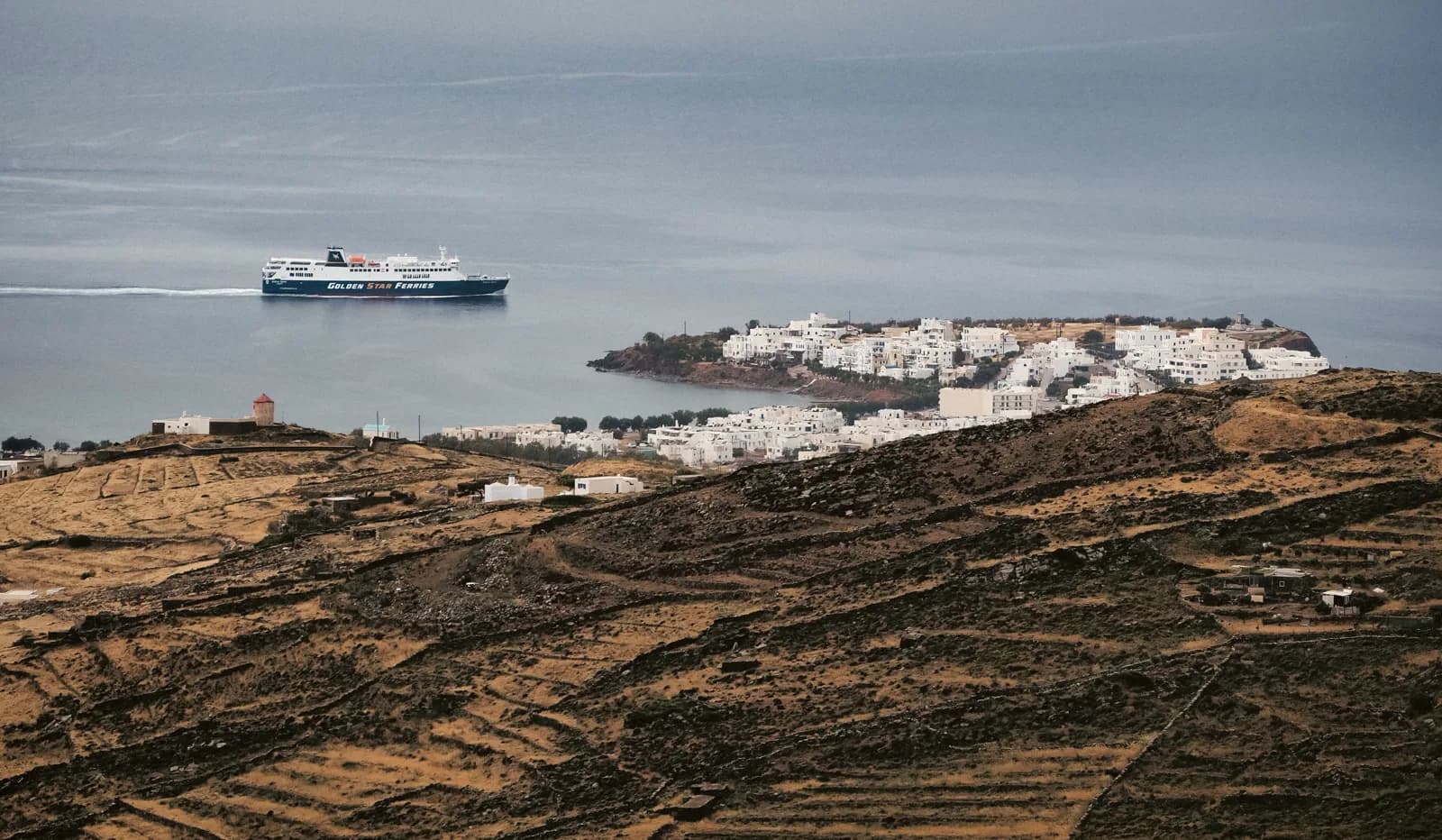
This is the question I get asked more than any other, and the honest answer is that it depends less on distance than most people assume. A ferry to somewhere in the Saronic Gulf or a nearby Cycladic island can be genuinely pleasant—an hour or two on deck, coffee in hand, watching the coastline change. But a ferry to Crete or the far Dodecanese can run seven or eight hours, and while overnight ferries with a cabin work for some travelers, they eat a day you don't have on a ten-day trip. My rule of thumb: if the ferry is under three hours and runs reliably in your season, take it—you get scenery and it's usually cheaper. If it's longer, or if you're traveling in shoulder season when schedules thin out, fly. Athens International connects to most island airports in under an hour, and a forty-minute flight beats a rough six-hour crossing every time.2
The other thing worth knowing: ferry schedules for the following season are often not published until relatively close to travel dates, and routes get consolidated or cancelled with little warning, particularly outside July and August. If your itinerary depends on one specific ferry connecting to one specific onward journey, build in a buffer day, or choose a flight instead. I've rebuilt more than one guest's itinerary at the last minute because a ferry they were counting on simply stopped running that week.
The Peloponnese Pairing: When to Choose Nafplio
For guests who want depth over island postcard views—history, food, dramatic landscapes, and a slower rhythm without ever setting foot on a boat—I pair Athens with the Peloponnese, based in Nafplio. It's an easy two-hour drive from Athens, no ferry required, which makes it the lowest-friction "second half" of a ten-day trip. From Nafplio you can reach Mycenae and the ancient theater at Epidaurus in a single morning, spend an afternoon wandering a genuinely beautiful Venetian old town, and still have days left for the beaches and villages of the Argolid. I've written in detail about why Nafplio deserves far more attention than it gets, and for guests who want their trip to feel unhurried and layered with real history rather than resort time, this is usually the pairing I recommend first.
A typical shape: Athens days one through three, then four nights based in Nafplio with day trips to Mycenae, Epidaurus, and the Mani or Monemvasia if you have the extra time, then back to Athens for a final night before your flight home. Guests who take this route almost always tell me afterward that the Peloponnese surprised them most—it's the part of Greece least represented in the photos everyone's seen beforehand, which somehow makes discovering it feel more like their own trip and less like recreating someone else's.
The Mainland Alternative: Delphi and Meteora
A third pairing I build less often, but which works beautifully for guests who've already done an island trip and want something different, swaps the coast for the mountains: Athens, then north to Delphi and on to Meteora. This route stays entirely on the mainland, so again no ferry logistics at all—just a rental car or a private driver. Delphi, ancient Greece's most sacred oracle site, sits dramatically on the slopes of Mount Parnassus and makes a natural stop en route north. Meteora's monasteries, perched on sheer rock pillars that seem to defy gravity, are unlike anything else in Greece and reward the extra driving distance completely. This pairing suits guests drawn to history and landscape over beach time, and it works particularly well in shoulder season or even winter, when the coastal options are less appealing anyway.
The Island Pairing: When to Choose Santorini or Another Cycladic Base
For guests who want that quintessential Greek island experience—whitewashed villages, sunset over the caldera, swimming—I pair Athens with one island, and I mean one. Santorini is the obvious draw, and it earns its reputation, but I always push guests to see past Oia's sunset crowds. There's a quieter side of Santorini most day-trippers never find: the black sand beaches of the southeast, the wine villages inland, Pyrgos and Emporio where actual Santorinians live. A ten-day trip built around Athens plus five or six nights on one island, rather than hopping between two or three, means you're not spending half your island time packing bags and waiting on a dock.
If Santorini's prices or crowds don't appeal, Naxos or a quieter Cycladic island can deliver a similarly authentic slower pace for less money and fewer people. The principle stays the same regardless of which island you choose: pick one, stay long enough to find a favorite taverna and a favorite beach, and resist the urge to add a second island "while you're out there."
What a Realistic Ten Days Actually Looks Like
Put together, here's the shape I build most often for first-time guests choosing the Peloponnese route: days one to three in Athens; days four through seven in Nafplio with day trips woven in; day eight travels back toward Athens with a stop at Corinth or a coastal lunch along the way; days nine and ten back in Athens for anything missed the first time, or a final relaxed stretch before the flight home. Swap the Peloponnese block for an island and the shape barely changes—Athens bookends the trip, and the middle stretch is where the actual character of your visit gets decided.
Notice what's absent from that shape: no third region, no "just one night" anywhere, no day where you're mostly in transit with a suitcase. That's deliberate. The itineraries that get remembered fondly are rarely the ones that covered the most ground.
The One Adjustment Almost Everyone Needs
If you take one thing from this: whatever itinerary you've sketched out, look for the stop that's shorter than two nights and either extend it or cut it. A one-night stay anywhere in Greece almost never works in your favor—by the time you've checked in, found dinner, and gotten your bearings, it's time to pack again. I'd rather send a guest home having deeply experienced two places than vaguely remembering five.
Every trip I build starts from a guest's actual priorities—history versus beach time, a slower pace versus wanting to see as much as possible, traveling with children or without—and the two-region structure above is simply the starting frame I adjust from there. You can see more of how these trips come together, day by day, over at a few sample itineraries I've put together from past guests' trips.
Ten days in Greece is enough time to fall in love with this country properly, but only if you resist the pull to see it all at once. I've watched guests try to do Athens, three islands, and the Peloponnese in ten days, and I've watched guests do Athens and one island, or Athens and one region, in the same ten days. It's always the second group that writes back a year later asking how soon they can return.
If you'd like help figuring out which pairing suits the trip you actually want—and getting the logistics right so you're not losing days to ferry schedules or overnight transfers—that's precisely what I do all day. I offer custom trip planning built around how you actually want to travel, not a template. Get in touch and let's put together your ten days properly.
References
- Visit Greece: Official Tourism Portal — Greek National Tourism Organisation
- Athens International Airport — Athens International Airport
- Ferryhopper: Greek Ferry Schedules and Routes — Ferryhopper